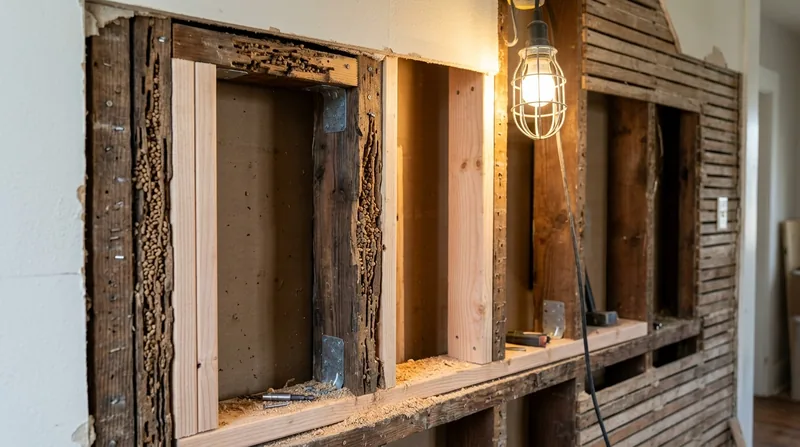




Long Beach's iconic Craftsman Bungalows and Period Revival homes, built between 1898 and 1949 along the bluffs and throughout Belmont Heights, Carroll Park, and California Heights, face a persistent threat from drywood termites thriving in the coastal marine layer and sandy soils of Los Angeles County. After a pest control professional treats a termite infestation, the structural damage remains: eaten-through studs, sill plates, floor joists, and trim must be replaced to restore the home's integrity. Termite damage repair in Long Beach is not cosmetic work, it is structural carpentry that rebuilds the frame your home depends on. We replace compromised wood members from your pest inspection report, working with the same carpenters on every job, restoring full strength to century-old bungalows and newer builds across Long Beach, Signal Hill, Lakewood, and surrounding communities. Our approach is straightforward: we document the damage, source materials that match the original species and grain where possible, and rebuild the frame without unnecessary replacement of sound wood. This page explains how termite damage repair works, what it costs in the Long Beach market, and how to choose a carpenter you can trust.
Why Termite Damage Repair Matters in Long Beach's Historic Homes
Drywood termites do not require soil contact; they live and breed inside the wood itself, eating through studs, joists, and trim from the inside out. A pest inspector identifies the damage, but the exterminator's work is chemical, not carpentry. Once treatment is complete, the eaten wood still cannot support loads, resist weather, or hold fasteners properly. In Long Beach's older neighborhoods, where Craftsman Bungalows feature exposed beam ceilings, load-bearing rim joists, and sill plates that anchor the entire structure, termite damage can compromise the safety and resale value of a home if left unrepaired.
- Termite-damaged studs lose their ability to carry wall loads and must be replaced or sistered (reinforced alongside the original member) depending on the extent of loss.
- Sill plates and rim joists that have been hollowed by termites allow the entire first floor to settle unevenly, causing doors to bind, floors to sag, and foundation cracks to appear.
- Floor joists eaten by termites no longer distribute live and dead loads evenly; sagging subfloors and soft spots underfoot are often the first signs a homeowner notices.
- Trim, fascia, and soffit damage may seem cosmetic but signals that the underlying framing may also be compromised and requires inspection.
Addressing termite damage promptly prevents secondary problems such as wood rot, water intrusion, and structural settlement that are far more expensive to repair later.
Key info: A 1925 Craftsman Bungalow in Belmont Heights with termite damage to the main floor's rim joist and three studs typically requires replacement of those members, new blocking, and reinforcement of the subfloor connection. This work often requires a permit from the Long Beach Building and Safety Division if it involves alterations to load-bearing members. Your pest inspector's report will specify which pieces are affected, and we use that report as our scope guide.
For more information on permits and structural requirements, homeowners can contact the Los Angeles Department of Building and Safety, which oversees Long Beach building codes and permit thresholds for structural alterations.
How We Repair Termite Damage: Our Process in Long Beach
We start with your pest inspection report, which identifies every piece of wood that has been compromised. We assess whether each member can be reinforced or must be fully replaced, then remove the damaged section, source matching wood (typically Douglas fir, redwood, or the original species if available), and install new framing using modern fastening and blocking standards. The goal is to restore the home to its original structural integrity without over-building or unnecessary demolition.
- We inspect the damage in person and compare the pest report to the actual condition, confirming which members need replacement and which can be reinforced.
- We remove the damaged wood section carefully, taking care not to disturb adjacent framing or finishes more than necessary.
- We source new lumber that matches the original species, dimension, and grade whenever possible, ensuring the repair blends structurally and visually with the existing frame.
- We install the new member with proper fastening, blocking, and connection details according to current building standards and your local code.
- We restore any finish carpentry, trim, or casing that was removed to access the damaged framing, returning the room to its original appearance.
The entire process, from removal to reinstallation and finishing, is performed by the same carpenters who understand both the old-house framing in Long Beach's Craftsman homes and modern code requirements.
Example: A Rose Park home built in 1912 had drywood termite damage affecting the south wall's bottom plate and two studs, discovered during a pest inspection. We removed the damaged sections, reinforced the rim joist connection with new blocking, installed pressure-treated lumber for the sill plate (standard for this application), and reinstalled the original baseboard and plaster casing. Work took three days, required a permit for the structural alteration, and cost $3,800. The home is now fully repaired and passed reinspection.
See our approach to wood rot and dry rot repair for related moisture and decay issues that often accompany termite damage in older homes.
Termite Damage Repair Methods and When to Use Each
| Approach | Description | Best for |
|---|---|---|
| Full Member Replacement | Remove the entire stud, joist, or sill plate and install new lumber of matching species and dimension, with new fastening and blocking. | Damage affecting more than 30% of a member's cross-section, or damage at critical connection points such as sill plates or load-bearing studs. |
| Sistering (Reinforcement) | Install a new member alongside the damaged original, bolted or fastened securely to restore combined load capacity without removing the original. | Damage affecting less than 30% of a member, or where the original framing has historical or aesthetic value worth preserving. |
| Localized Section Replacement | Cut out only the damaged portion of a long member (e.g., a floor joist or rim joist), install a new section with proper scarf joints or butt connections, and reinforce with blocking. | Damage confined to a small section of a longer member, such as the bottom 2 feet of a rim joist or the end of a floor joist. |
| Subfloor and Decking Replacement | Remove and replace sections of subfloor, tongue-and-groove decking, or finish flooring that have been compromised by termite activity. | Damage visible from below or detected during a floor sag assessment; often combined with joist repair to ensure a solid, level floor surface. |
Termite Damage Repair Cost in Long Beach: What to Expect
Termite damage repair costs depend on the number of members affected, their size, accessibility, and whether the work requires a permit. A single stud replacement might cost $1,200 to $1,800; damage involving multiple joists, a sill plate, and subfloor sections typically runs $3,500 to $6,500. Large-scale damage affecting an entire wall or multiple rooms can exceed $10,000 and requires an on-site estimate. The Long Beach market for structural carpentry reflects the age and construction quality of our housing stock: older homes often have larger timber members and more complex connections that take longer to repair than newer post-war or modern framing.
- Extent of damage (number and size of members) is the primary cost driver; one damaged stud costs far less than four studs, a rim joist, and subfloor sections.
- Accessibility and site conditions affect labor time; damage behind walls, under floors, or in tight crawl spaces takes longer to reach and repair than exposed framing.
- Material costs vary by species and lumber grade; Douglas fir and pressure-treated lumber for sill plates are standard and widely available in Long Beach.
- Permits and inspections add time and cost if structural members are involved; your local building department will advise whether a permit is required based on the scope.
- Finish carpentry and restoration of trim, casing, or flooring may be necessary to return the room to its original condition, adding to the total job cost.
We recommend getting two or three estimates from local carpenters so you can compare scope, materials, and pricing. See our full pricing overview for more detail on cost factors and how we structure estimates.
Termite Damage Repair Near Me: What to Look for When Hiring a Carpenter in Long Beach
Choosing a carpenter for termite damage repair is a decision that affects your home's structural integrity and your peace of mind. Look for a local shop where the same carpenters do the work on every job, not a franchise that sends different crews. Ask about experience with older Long Beach homes, Craftsman Bungalows, and period-specific framing details. Verify that the carpenter is fully insured and can provide references from recent structural jobs. Understand whether a permit is required for your specific repair, and confirm that the carpenter will work with your local building department to obtain it if needed.
- Confirm that the carpenter is fully insured and can provide a certificate of insurance covering general liability and workers compensation.
- Ask for references from at least two homeowners who had structural or termite damage repair done in the past two years.
- Request a written estimate that specifies which members will be replaced or reinforced, the materials to be used, and whether a permit is required.
- Verify that the carpenter understands Long Beach building codes and will coordinate with the Long Beach Building and Safety Division if a permit is needed.
- Check whether the carpenter has experience with your home's age, style, and original framing materials; older Craftsman homes often require period-appropriate techniques and materials.
- Understand the timeline; most single-wall repairs take 3 to 5 days, but larger jobs may take 2 to 3 weeks depending on permit delays and complexity.
Once you have selected a carpenter, be prepared to provide your pest inspection report and any prior structural assessments or engineer's reports. Contact us at Long Beach Carpentry for a free estimate, and we will inspect the damage, explain your repair options, and provide a detailed scope and price within 24 hours.
Termite Damage Repair in Long Beach: Pricing Guide
| Service | Price | Details |
|---|---|---|
| Single stud replacement | Starting at $1,200 | Removal, new lumber, fastening, and basic finish restoration for one compromised stud member |
| Sill plate or rim joist repair | Starting at $2,500 | Localized section replacement with blocking and connection reinforcement; cost increases with length and complexity |
| Multiple members and subfloor | Starting at $3,800 | Repair of three or more studs, joists, or sill sections plus subfloor replacement and finish carpentry restoration |
| Large-scale damage or whole-wall repair | On estimate | Multiple rooms, extensive framing replacement, or structural alterations requiring engineer review or major permit coordination |
| Travel and consultation | Included | No separate mileage fee or call-out charge in Long Beach and surrounding service areas |
| Free estimate | No obligation | Response within 24 hours at (562) 418-6699; includes site inspection and written scope |
Indicative pricing, the exact cost depends on square footage, finish, and site access. Free personalized estimate within 24h at (562) 418-6699.


