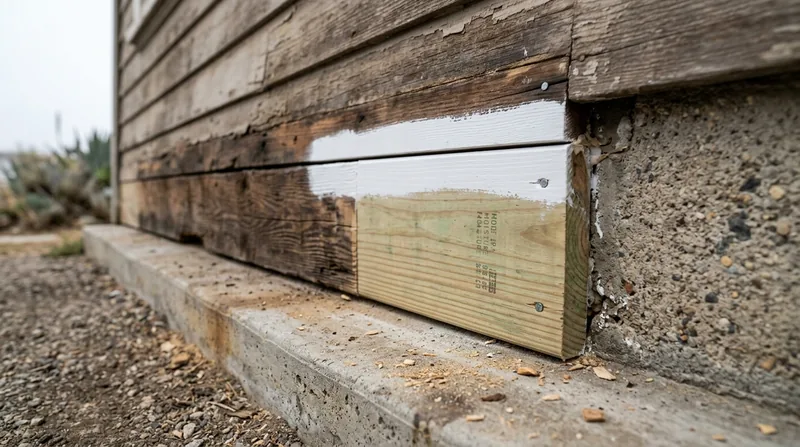




Long Beach's coastal marine-layer humidity and salt air off the Pacific keep wood rot and dry rot repair active year-round, especially in the pre-1950s Craftsman bungalow stock of Bluff Park, Bluff Heights, and Belmont Heights. The combination of ocean moisture, sandy and expansive clay soils, and aging wood framing creates ideal conditions for decay in sill plates, rim joists, floor joists, and exterior trim. We cut out decayed wood, treat the surrounding framing, and rebuild with rot-resistant lumber, a permanent repair rather than a cosmetic patch. Unlike quick fixes that hide the problem, our approach removes the failed wood entirely and rebuilds with material rated for Long Beach's damp coastal environment. Whether the damage is in a Victorian-era siding, a Craftsman bungalow's basement rim joist, or a 1920s Spanish Colonial Revival home's exterior trim, we document the scope and return your home to sound structural condition.
Why Wood Rot and Dry Rot Repair Matters in Long Beach's Older Homes
Long Beach's residential stock is dominated by homes built between 1898 and 1949, when builders used Douglas fir, redwood, and other softwoods that perform well in dry climates but fail rapidly under sustained moisture. The coastal marine layer delivers fog and salt spray six to nine months a year, and the Port of Long Beach and San Pedro Bay anchor moisture-laden air directly over neighborhoods like Bluff Park and Belmont Heights. Rot does not stabilize once it starts; it spreads into adjacent framing, weakens structural members, and eventually affects floor levelness, door operation, and load-bearing capacity. Catching decay early and removing it completely prevents exponentially larger repairs down the road.
- We identify rot by probing with a screwdriver and examining wood grain, color, and texture to confirm active or arrested decay.
- Coastal humidity in Long Beach keeps wood moisture content above the 20 percent threshold where fungal growth accelerates year-round.
- Rot in rim joists and sill plates can go unnoticed until floor bounce or nail pops signal structural movement.
- Removing decayed wood and replacing it with pressure-treated lumber or naturally rot-resistant species stops the spread and restores strength.
Delaying rot repair is the most common mistake homeowners make, because early-stage decay looks minor and feels like a cosmetic issue until it compromises a structural member.
Local example: A 1920s Craftsman bungalow in Belmont Heights with rot in the front porch rim joist and the sill plate where the band board meets the foundation. The homeowner noticed soft spots in the porch decking and a slight gap opening between the siding and the foundation. We removed 14 linear feet of compromised rim joist, treated the remaining band board with a penetrating wood preservative, and sistered in pressure-treated lumber bolted to the existing frame. The repair took three days and cost far less than the foundation underpinning and full joist replacement that would have been necessary if the rot had continued unchecked for another two years.
For guidance on permitting and structural assessment, consult the City of Long Beach Department of Development Services to confirm whether your repair requires a building permit and inspection.
How We Repair Wood Rot and Dry Rot in Long Beach Homes
Our repair process begins with a thorough inspection to establish the extent of decay, identify the moisture source, and determine whether the damaged wood can be repaired or must be replaced. We use a moisture meter and a sharp probe to map the boundary between sound and decayed wood, then remove all compromised material. Once the cavity is clean and dry, we treat the surrounding wood with a water-based wood preservative, allow proper drying time, and rebuild with pressure-treated lumber, naturally rot-resistant redwood, or other species rated for wet environments. The goal is a permanent repair that performs for decades in Long Beach's marine climate.
- We probe and measure the extent of decay using a screwdriver, moisture meter, and visual assessment to determine the repair scope.
- We remove all rotted wood back to sound framing, creating clean edges and a dry cavity ready for treatment.
- We apply a penetrating wood preservative to the exposed framing and allow adequate drying before reconstruction.
- We rebuild the damaged section using pressure-treated lumber, redwood, or other rot-resistant species bolted or fastened securely to the existing structure.
- We seal the repair with exterior caulk or flashing where appropriate to prevent moisture re-entry and ensure the repair lasts.
This methodical approach prevents the decay from recurring and restores full structural function to the repaired member.
Concrete example: A 1905 Victorian home in Rose Park with extensive rot in the exterior trim boards, siding, and the corner stud framing where water had been running down from a failed gutter. We removed 24 linear feet of compromised trim and 8 linear feet of rotted stud, treated the adjacent framing with preservative, and rebuilt the corner with pressure-treated lumber, new flashing, and caulking. The homeowner also installed new gutters and downspouts to address the moisture source. Total repair time was five days, and the corner now sheds water cleanly.
Related structural work, such as floor joist and subfloor repair, often accompanies rot repairs in older Long Beach homes where moisture has affected multiple framing members.
| Repair Approach | Description | Best For |
|---|---|---|
| Localized wood replacement | Remove decayed section, sister in pressure-treated lumber or redwood, bolt securely to existing frame. | Rot confined to rim joists, sill plates, exterior trim, or fascia boards in otherwise sound framing. |
| Full member replacement | Remove the entire rotted joist, rim board, or stud and install a new member of matching dimension and species. | Rot extends across the entire depth or length of a structural member, or decay has compromised more than 30 percent of the member. |
| Preservative treatment and monitoring | Apply water-based wood preservative to early-stage decay or wood at risk, monitor moisture levels, and address the moisture source. | Soft spots or discoloration detected early, before structural integrity is compromised, and moisture source can be controlled. |
| Flashing and moisture control upgrade | Install or upgrade flashing at roof-to-wall transitions, around windows and doors, and at grade level; improve drainage and ventilation. | Rot is driven by water intrusion from gutters, downspouts, window leaks, or poor grading; addressing the source prevents recurrence. |
Wood Rot and Dry Rot Repair Cost in Long Beach: What to Expect
Wood rot repair in Long Beach typically starts at $650 for a small, localized repair in accessible trim or fascia, and scales upward based on the extent of decay, the structural members involved, and access difficulty. A rim joist repair affecting 12 to 16 linear feet, common in pre-1950s homes, generally runs $1,200 to $2,500 depending on whether sistering or full replacement is required. Larger jobs involving multiple joists, sill plates, or structural studs may exceed $4,000 and usually require an on-site estimate. The largest factor affecting cost is whether the repair is truly localized or whether rot has spread through multiple framing members, necessitating more extensive removal and rebuilding.
Other cost drivers include access (crawl space versus attic versus exterior wall), the species of replacement lumber (pressure-treated standard framing versus redwood or other naturally rot-resistant species), and whether the moisture source requires concurrent repairs such as new gutters, flashing, or grading work. We recommend getting 2 to 3 estimates from local carpenters so you can compare scope, materials, and timeline. Many Long Beach homeowners also use rot repair estimates to document damage for homeowner's insurance claims, though we do not predict claim approval or coverage.
For a detailed breakdown of pricing by repair type and size, visit our pricing page. Call us at (562) 418-6699 for a free, no-obligation estimate; we respond within 24 hours.
What to Look for When Hiring a Carpentry Contractor Near Me in Long Beach
Finding the right carpenter for wood rot repair in Long Beach means checking that the contractor is fully insured, has verifiable references from similar homes in your neighborhood, and understands the specific challenges of coastal moisture and pre-1950s framing. Ask to see proof of insurance coverage and request contact information for three recent Long Beach clients so you can ask about the quality of the work and whether the job stayed on schedule. If your home is in a historic district or a Craftsman preservation zone, confirm that your contractor has experience matching original materials and trim profiles. For any structural work, such as replacing load-bearing rim joists or sistering joists, check with the City of Long Beach Department of Development Services to understand permit requirements for your specific repair.
- Request proof of insurance and ask about coverage limits for property damage and liability.
- Interview at least two or three carpenters and compare their scope of work, material choices, and timeline estimates.
- Ask for references from Long Beach homeowners with similar homes and similar rot repairs completed in the past two years.
- Clarify whether the estimate includes the moisture source repair (gutters, flashing, grading) or whether that is a separate scope.
- Confirm that the contractor will obtain any required building permits and will be available for city inspections if the repair involves structural framing.
- Ask whether the contractor will provide a written warranty on the repair and what it covers.
A reputable local carpenter will walk you through the repair process, explain why certain materials are chosen for Long Beach's climate, and stand behind the work with a clear warranty.
Ready to schedule your free estimate? Contact Long Beach Carpentry at (562) 418-6699. We serve Long Beach, Signal Hill, Lakewood, Bellflower, and surrounding areas in Los Angeles County.
Wood Rot & Dry Rot Repair in Long Beach: Pricing Guide
| Service | Price | Details |
|---|---|---|
| Small localized trim or fascia repair | Starting at $650 | Includes removal of decayed wood, preservative treatment, and replacement with pressure-treated lumber or redwood in accessible locations |
| Rim joist or sill plate repair | Starting at $1,200 | Covers 12 to 16 linear feet of rot removal, treatment, sistering or replacement, and fastening to existing framing; larger spans cost more |
| Multi-member structural repair | On estimate | Rot affecting multiple joists, studs, or load-bearing members requires site inspection to assess extent, access, and replacement scope before pricing |
| Moisture source repair add-on | Varies | Flashing, gutter replacement, or grading work to stop water intrusion is often necessary and priced separately based on scope and materials |
| Travel and estimate | Included and free | No mileage charge in Long Beach and surrounding service areas; free estimate response within 24 hours at (562) 418-6699 |
Indicative pricing, the exact cost depends on square footage, finish, and site access. Free personalized estimate within 24h at (562) 418-6699.


